
Criminal Records in Kalawao County
Kalawao County criminal records are handled through state-level resources rather than a local government office, because the county has no elected government and no formal police department. If you need to search criminal history records, court case filings, or arrest data connected to Kalawao County, you will use the Hawaii Criminal Justice Data Center and the Second Circuit Court in Wailuku, Maui. This page explains the county's unique structure and tells you exactly where to look for records.
Kalawao County Overview
How Kalawao County Works
Kalawao County is the smallest county in the United States by area. It covers just 1.2 square miles on the Kalaupapa Peninsula on the island of Molokai. The peninsula sits below sea cliffs that rise more than a quarter mile high. The only land access is a mule trail. Today, about 82 people live there, most of them elderly former patients who chose to stay after the quarantine ended.
There is no county government here. No county mayor, no county council, no county police department. The Hawaii State Department of Health administers the county directly. For law enforcement, the state designates a local resident to handle day-to-day matters. For anything serious, the Maui County Police Department steps in. This is not a small detail when it comes to criminal records. It means that if you are looking for records tied to Kalawao County, you will not find a local police department to call. The right path is through state resources.
The peninsula is coextensive with Kalaupapa National Historical Park, which is managed by the National Park Service. Visitors need NPS permits to enter the settlement. The park preserves the history of the Hansen's disease isolation colony that operated here for more than a century. The screenshot below shows the Kalaupapa NHP homepage.
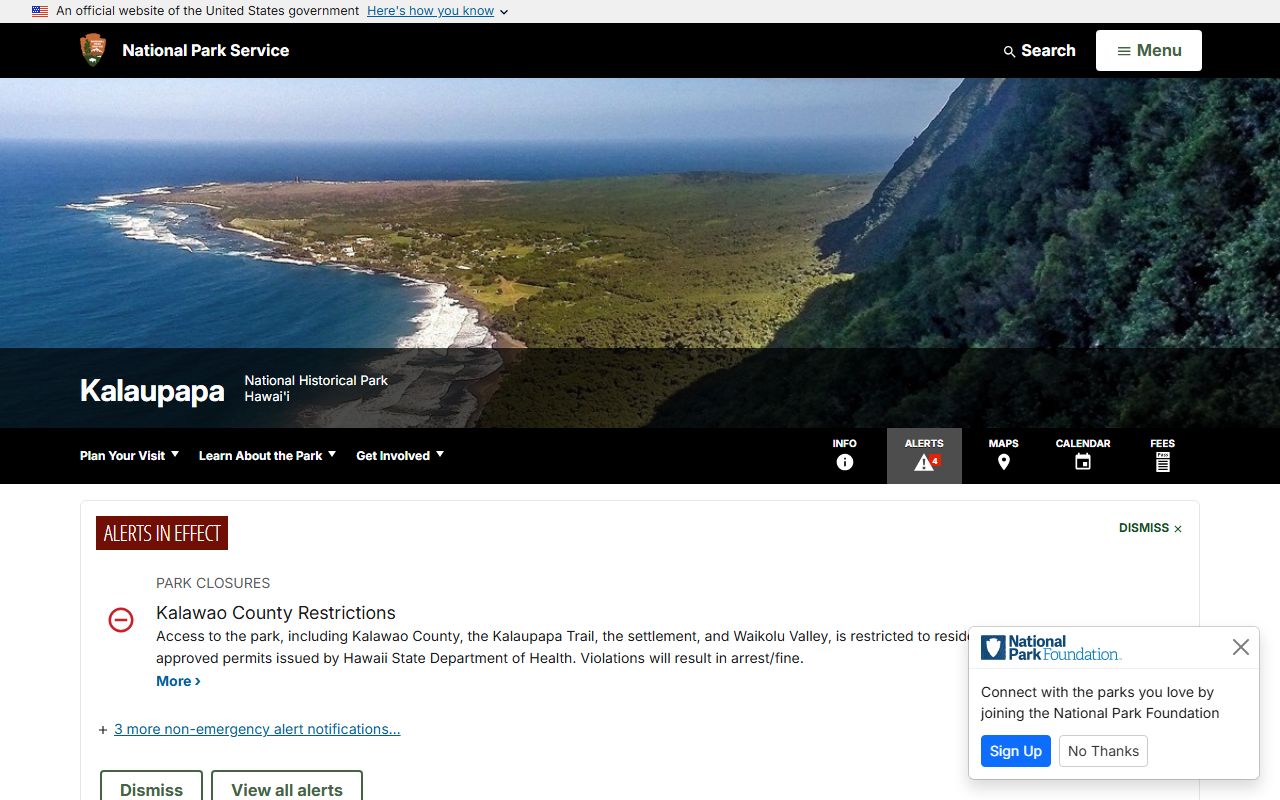
The National Park Service manages the Kalaupapa Peninsula in coordination with the State of Hawaii. Its website is the primary public resource for understanding how Kalawao County functions today.
Historical Background and Why It Matters for Records
Understanding the history of Kalawao County is not just interesting. It directly explains why the record system works the way it does. The settlement was established in 1866 as a place to isolate people diagnosed with Hansen's disease, then called leprosy. The first 12 patients arrived on January 6 of that year. At its peak in 1903, the population was 888 people. By 1924, it had fallen to 485. Medical treatment became available in the 1940s and 1950s, and the quarantine policy was formally lifted in 1969.
After 1969, the remaining patients were allowed to leave or stay. Most chose to stay. No new patients or permanent residents have been admitted since. The county's tiny population of around 82 people is what remains. Most are elderly. The settlement was historically governed by the Board of Health, which enforced strict rules including sanctions for firearms possession, alcohol, assault, trespassing, and leaving without a permit. That enforcement structure is a direct ancestor of the current arrangement where the State Department of Health still runs the county. You can read more about this history on the NPS history page for Kalaupapa.
The NPS history page covers the full arc of Kalaupapa's past. It is useful background for understanding why Kalawao County has no independent government and relies on state and Maui County systems for criminal justice matters.
The practical effect of this history for records researchers is simple. There is no Kalawao County Police Department. There is no county jail. There is no county court. Any criminal matter that arises involving a Kalawao resident goes through either the state-level HCJDC system or the Second Circuit Court in Maui. That is where you need to look.
Getting Criminal Records for Kalawao County
Because Kalawao County has no local criminal justice infrastructure, all criminal history record checks for residents or cases tied to the county run through the Hawaii Criminal Justice Data Center. The HCJDC is the statewide repository for all adult criminal conviction information. It does not matter which county a person lives in. The same system covers everyone in Hawaii, including Kalawao.
The fastest way to search is through eCrim, Hawaii's online criminal records portal at ecrim.ehawaii.gov. You create an account, search by name, and pay per search. Each unique search costs $5.00. A certified record runs $12.00. The system shows conviction data only, not arrests that did not result in a conviction. Results come through immediately after payment. Some agencies will not accept online printouts, so confirm what format the requesting party needs before you run the search.
You can also request records by mail. The HCJDC mailing address is 465 S. King Street, Room 102, Honolulu, HI 96813. Mail-in name-based checks cost $30.00 for the basic report. Add $20.00 for a certified copy. Payment must be by money order or cashier's check only. Cash is not accepted. Processing takes 3 to 5 business days for standard requests and 7 to 10 business days if you need the record notarized.
The screenshot below shows the HCJDC website, which is the main entry point for all criminal history record requests in Hawaii, including those for Kalawao County residents.
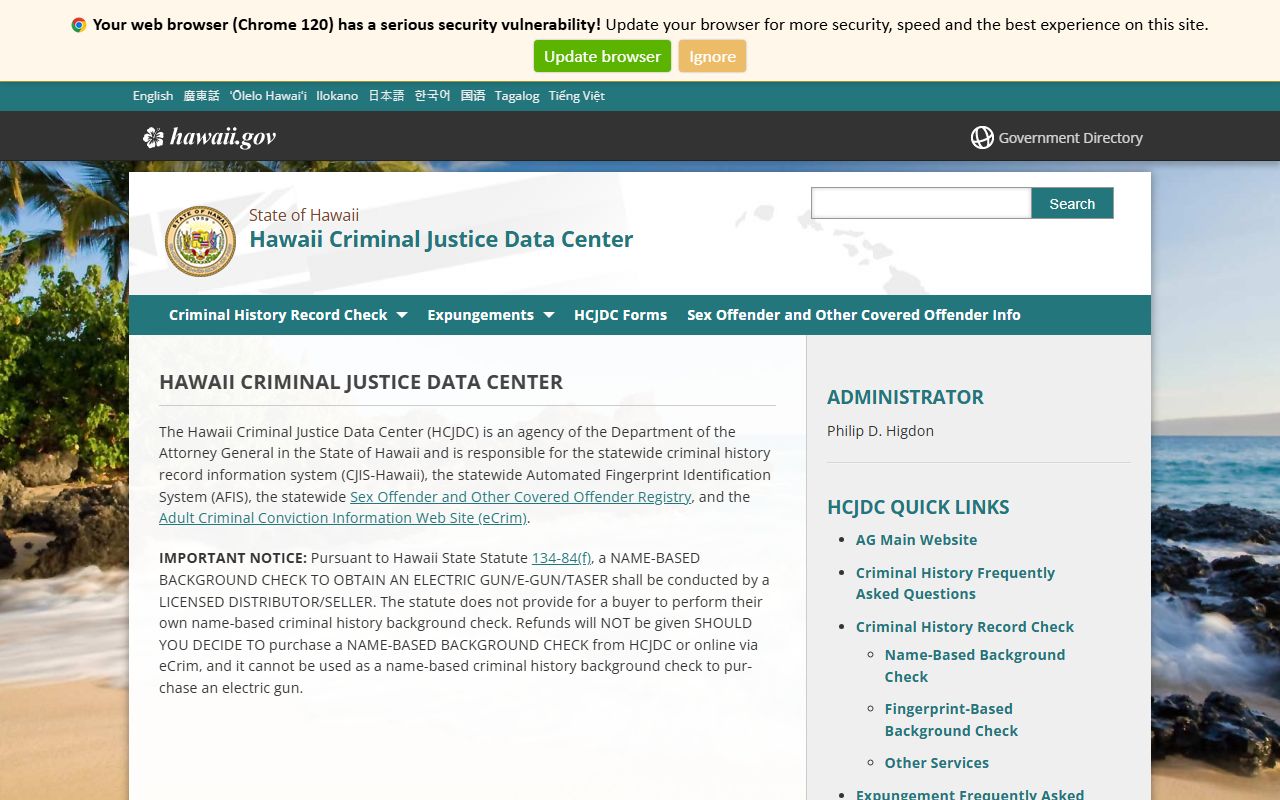
The HCJDC website at ag.hawaii.gov gives you access to eCrim, fee schedules, downloadable request forms, and instructions for mail and in-person requests.
Note: HCJDC does not handle juvenile record checks. For juvenile records, contact the Hawaii State Judiciary Family Court Juvenile Records Department at (808) 954-8190.
Second Circuit Court - Maui
Kalawao County falls under the jurisdiction of the Second Circuit Court, which is based in Wailuku, Maui. Any court proceedings for Kalawao County residents, including criminal cases, are handled at this court. If you are looking for court records tied to someone from Kalawao County, the Second Circuit is where those files would be.
| Court | Second Circuit Court (Maui / Kalawao) |
|---|---|
| Address | 2145 Main Street Wailuku, HI 96793 |
| Phone | (808) 244-2929 |
| Website | courts.state.hi.us - Second Circuit |
You can search court records for the Second Circuit through the statewide eCourt Kokua portal. Basic case information is free. Downloadable documents cost $3.00 per document for up to 30 pages, then $0.10 per page beyond that. Certified copies run $5.00 each. You can search by party name, case ID, or citation number. District Court criminal cases filed before August 2012 are not available through the online system. For older records, contact the Second Circuit Court Clerk's office in Wailuku directly.
Given the tiny population of Kalawao County, court activity tied specifically to the county is extremely rare. The Second Circuit Court handles far more cases from Maui and the rest of the island chain. But the Second Circuit is the correct jurisdiction, and any records that do exist would be on file there.
Records Access Law in Hawaii
The same state laws that cover every other Hawaii county apply to Kalawao. Hawaii Revised Statutes Chapter 846 governs the HCJDC and criminal history record checks statewide. The Uniform Information Practices Act in HRS Chapter 92F sets the default rule that government records are open to the public. Agencies can only withhold records under specific exceptions spelled out in the law.
For Kalawao County, the practical implication is that any law enforcement records created in connection with the county, whether arrest records, incident reports, or booking data, would flow through either the state system or Maui County. A records request would go to the HCJDC for criminal history, or to the Second Circuit Court for case filings. There is no local agency to contact. That actually makes the process simpler in one sense: there are fewer doors to knock on.
Expungement rights under HRS § 831-3.2 apply equally to Kalawao residents. Someone with a conviction or a non-conviction arrest record can petition for expungement if they meet the statutory criteria. After a successful expungement, the HCJDC removes that entry from the public record and it will not show up in eCrim searches. Juvenile records are sealed at age 18 under separate provisions of state law.
How to Search Kalawao County Criminal Records Step by Step
Here is what to do depending on what you need.
If you need a criminal history check on a specific person, go to the eCrim portal at ecrim.ehawaii.gov. Create an account, run a name search for $5.00, and purchase the report for $12.00 if you find something. This covers conviction records statewide and is the fastest option. If the person has Kalawao County ties, that history will appear in the same system as any other Hawaii resident.
If you need a court record or case file, use the eCourt Kokua search tool. Search by name or case number. If you cannot find the record online, call the Second Circuit Court Clerk at (808) 244-2929. The Clerk can search for cases by name and tell you what is available. For certified copies, you either request them online through eCourt Kokua or submit a written request to the court clerk in Wailuku.
If you need to understand who administers the county or need to contact any official about a Kalawao matter, the Hawaii State Department of Health is the right agency. The Department of Public Safety handles corrections statewide, including any sentences served by Kalawao County residents.
Note: For any serious law enforcement concern involving the Kalaupapa Peninsula, contact Maui County Police Department or call 911. The NPS ranger staff at Kalaupapa National Historical Park can also help direct you to the right agency.
Communities in Kalawao County
Kalawao County consists entirely of the Kalaupapa Peninsula on Molokai. The Kalaupapa settlement is the only community. No cities in Kalawao County meet the population threshold for individual city pages. With around 82 residents, the entire county is smaller than many apartment buildings. All record requests go through state-level offices or the Second Circuit Court in Maui.
Nearby Counties
Kalawao County is surrounded by Maui County, which covers the rest of Molokai and handles court proceedings for Kalawao residents. Maui County has its own police department, courts, and criminal records resources.